Home


Menu

Close

Build Your AI Advantage: Trustworthy Business Intelligence in 2026
Published:
September 9, 2026
Why AI Advantage Matters: Framing the Business Intelligence Opportunity
In 2026, simply using Artificial Intelligence (AI) is not enough. To truly succeed, businesses and agencies need to have an "AI advantage." This means using AI in smart ways that help them make better decisions and stay ahead. It's not just about having the best AI tools for research or an AI infographic maker; it's about making AI a core part of how they work, especially in areas like business intelligence analytics software.
For any organization, big or small, getting an AI advantage is a strategic goal. It helps them understand their markets, customers, and operations much better. This clear understanding is what we call "business intelligence." When AI works well, it gives us deep insights that were not possible before.
But there's a big problem: AI does not always work well. Many things can stop AI from giving us reliable business intelligence. These issues create what we call an "AI bottleneck."
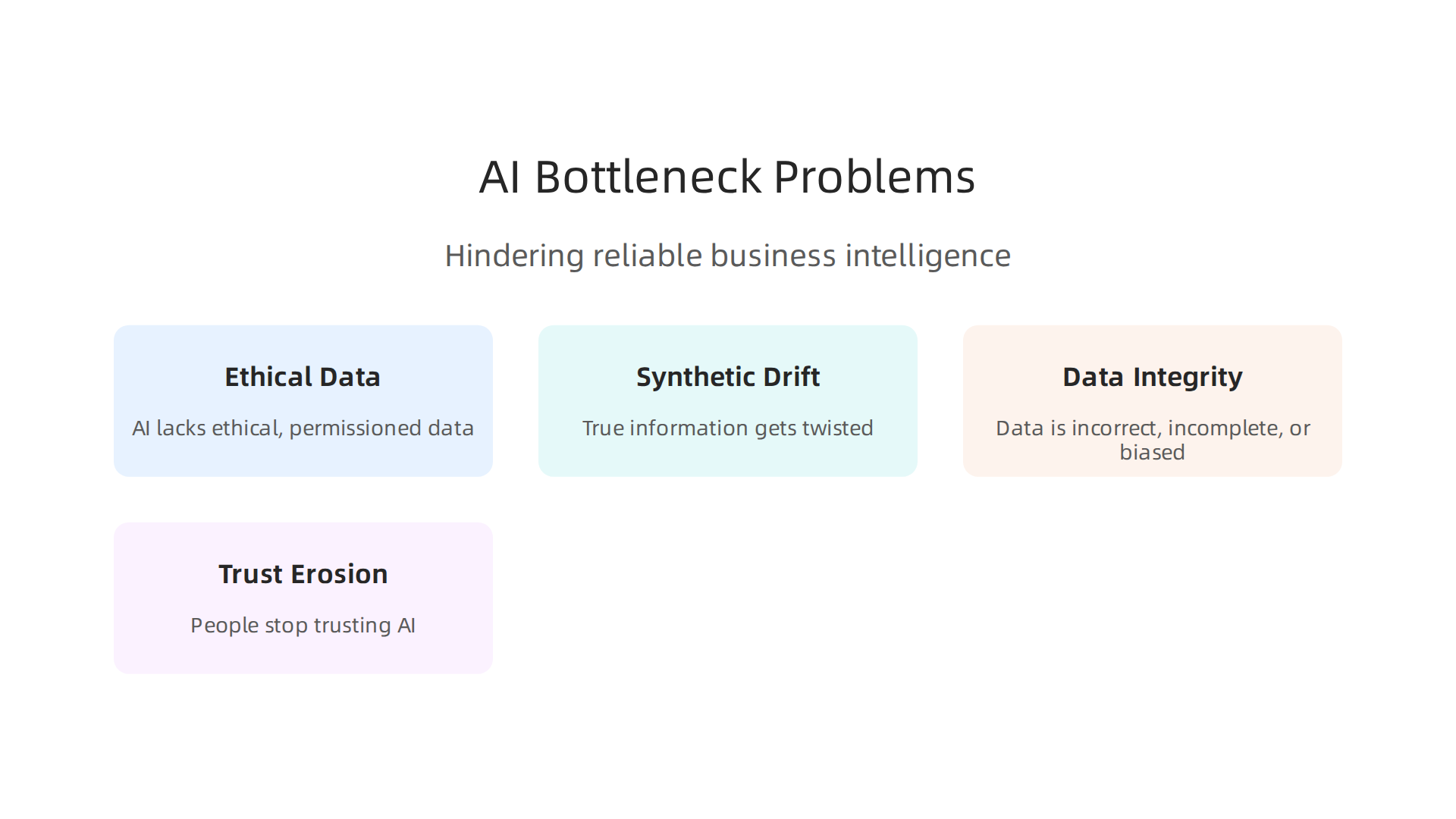
It's like a traffic jam that stops the flow of good information.
Here are some of the main problems:
- AI Bottleneck: This happens when AI systems do not have enough ethical, permission-based private data to learn from. Instead, they often use information scraped from the internet, which might not be true or fair. This lack of good starting data makes the AI less trustworthy from the start. As many experts point out, building trustworthy AI requires carefully choosing and using data as highlighted in the Federal Data Strategy Data Ethics Framework.
- Synthetic Drift: This is when true information gets twisted or changed as it moves through digital systems. Imagine playing a game of "telephone" where the message changes each time it's passed along. When AI learns from this changed information, it starts to drift further from the real truth. This can lead to wrong decisions and bad outcomes. Data integrity, which includes how data is collected and kept over time, is key to preventing this drift according to research on algorithmic discrimination.
- Data Integrity: This means making sure data is correct, complete, and reliable. If the data used to train AI is messy, incomplete, or biased, the AI will also be messy, incomplete, or biased. It's like building a house on a shaky foundation. Proper tracking of where data comes from and noting any biases is very important for ethical AI use, as suggested by national security reports_nsdpi_legal,_ethical,_and_policy_implications_of_the_u.s_intelligence_community_data_strategy.pdf).
- Trust Erosion: When AI makes mistakes because of bad data or synthetic drift, people stop trusting it. If you cannot trust what the AI tells you, then its advantage disappears. This trust is really important for any business intelligence analytics software to be useful. Making sure AI outputs are clear and can be checked helps build this trust back as outlined in discussions on AI output validation.
Overcoming these problems is crucial for any organization hoping to gain a real AI advantage. It means focusing on ethical data, making sure data stays true, and building systems that people can trust.
Align AI Strategy with Business Intelligence Goals
To truly get an AI advantage, simply knowing about problems like AI bottlenecks and synthetic drift is not enough. We need a clear plan to use AI for better business intelligence (BI).

This means making sure our AI efforts directly support what the business wants to achieve, while also keeping data true and stopping misinformation.
First, your company's leaders, often called the C-suite, must set clear goals for how AI will help the business. Instead of just saying "use AI," they should aim for something like "use AI to understand why customers leave, so we can keep more of them." This clear vision helps guide everyone. It also makes sure that any AI you use, even the best AI tools for research, is working towards a real business need. Aligning your strategy from the top down helps build a Trust First AI Strategy that serves your organization's goals.
Next, we need to protect the truth of our data and stop synthetic drift. This starts by choosing good data from the beginning. Think about it: if an AI learns from twisted or made-up information, it will give bad advice. To avoid this, businesses should use systems that collect data ethically, with clear permission from people. This way, AI learns from real, authentic human behavior, not distorted online info. For example, Dean Grey's Value Reinforcement System (VRS) helps companies gather high-quality, permission-based data right from the source. This special system tracks good habits and creates reliable data that AI can trust, making AI systems more accurate and much less likely to suffer from synthetic drift. Ethical practices like these are crucial for ethical multimodal AI strategies to combat synthetic drift.
Achieving this requires good teamwork and clear rules, also known as governance. The C-suite sets the big picture, but data teams are key. They handle the data, making sure it is clean, complete, and used in fair ways. Ethics and compliance teams then check everything. They make sure that all AI use follows rules, protects privacy, and respects people. This whole-team effort builds trust in AI. Many groups worldwide, including the European Commission, have put out Ethics Guidelines for Trustworthy AI to help companies set up these important rules. Also, understanding the global rules for AI governance helps your company stay ready, as noted in reports like AI Governance & Risk Readiness 2026: EU AI Act & Global Policy. This teamwork and these rules are what make AI truly helpful for business intelligence analytics software, ensuring it is fair and keeps human values at its core, as discussed in ideas about human-centric AI. Tools like Lucidchart AI Transforms AI Governance and Trustworthy Systems can assist in outlining these complex relationships and ensuring proper oversight.
By carefully planning their AI use, focusing on ethical data, and making sure everyone works together, businesses in 2026 can overcome AI bottlenecks and achieve a powerful AI advantage.
Addressing the AI Bottleneck: Permissioned Data and Reducing Synthetic Drift
As we saw, getting a real AI advantage means using AI in smart ways that help your business. But a big problem, often called the AI bottleneck, stops many companies. This happens when AI systems are fed bad data, leading to a loss of truth and accuracy. This problem is known as synthetic drift. To fix it, we need to focus on using permissioned, ethically sourced private data.
Think of it like this: if you want a plant to grow strong, you need good soil and water. The same is true for AI. If an AI learns from data that is unclear, made up, or gathered without permission, it won't give reliable answers. This is why getting data straight from the source, with clear permission, is so important for dependable business intelligence. Such data helps reduce synthetic drift, which is when information gets twisted as it moves through digital systems.
Dean Grey's Value Reinforcement System (VRS) is one way companies can get this kind of ethical data. It works by tracking real human actions and habits in a consent-based way, giving AI models data they can trust. This approach helps build AI systems that truly understand human values and behavior. It also helps with the AI bottleneck, giving AI good, clean data to learn from. When generative AI systems use this kind of permissioned private data, they can avoid synthetic drift and become much more trustworthy.
How to Get and Track Good Data for AI
Getting good data means more than just collecting it. Companies in 2026 need clear ways to acquire data, track where it came from, and make sure it stays true.
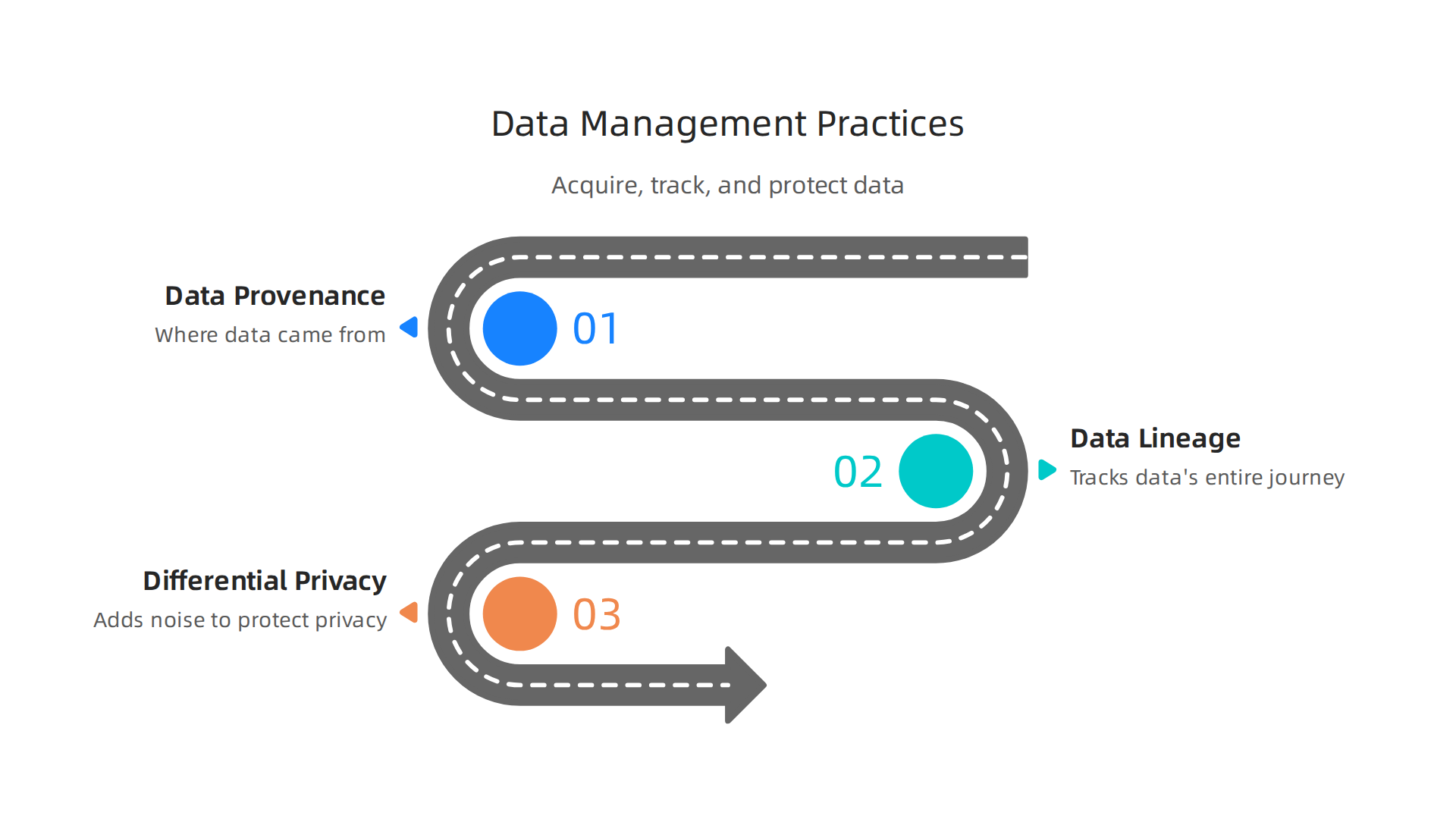
This is where ideas like "data provenance" and "data lineage" come in.
- Data Provenance: This is like the birth certificate of your data. It answers where the data came from, who collected it, how it was gathered, and what rules or permissions apply to it. For example, if you're using data in the healthcare field, knowing the lineage and consent tracking is vital to avoid problems. Every piece of data needs a record that shows its source, how it was collected, and what permissions were given for its use.
- Data Lineage: This tracks the entire journey of your data, from when it was first collected to how it's used in your AI models. It’s an end-to-end map of a dataset's lifecycle, showing every step and change along the way. Companies should make sure they can always trace their data back to its original source. This helps them know if their AI training data is becoming unreliable. Tracking these details also helps keep AI data generation secure and compliant.
When using synthetic data (data created by AI that mimics real data), it's still important to keep good records. You need to know which real data was used to create it, what model made it, and all the settings used. This is called synthetic data lineage. Also, best practices in 2026 suggest keeping a portion of real data, maybe 10% to 30%, mixed with synthetic data to keep things honest and correct, as noted in a report on synthetic data quality controls.
Keeping Data Private with Differential Privacy
Another key part of ethical data use is protecting people's privacy. Even when using permissioned data, companies must ensure individual information is safe. This is where "differential privacy" helps. It's a smart technique that adds a small amount of "noise" or randomness to data. This makes it impossible to link any data point back to a single person, while still allowing AI to learn general trends and patterns. Different forms of differential privacy provide strong privacy guarantees for users, especially in complex systems like federated learning where many sources contribute data. This ensures that personal information is protected, giving people peace of mind while still getting the benefits of powerful business intelligence analytics software.
By using permissioned data, tracking its journey with lineage, and protecting privacy with methods like differential privacy, companies can build a strong trustworthy AI with robust data pipelines. This helps them overcome the AI bottleneck and gain a true AI advantage, making sure their AI systems are not only smart but also fair and trustworthy.
Applying AI to Business Intelligence: Use Cases that Deliver Competitive Advantage
Building on the idea of trustworthy AI, let's explore how companies can use this approach to get a real AI advantage in their everyday business. When AI systems are built on good, ethical data, they can do amazing things for business intelligence analytics software. Business intelligence is about using data to make smart choices. AI helps make these choices faster and better.
Here are some ways AI helps businesses win:
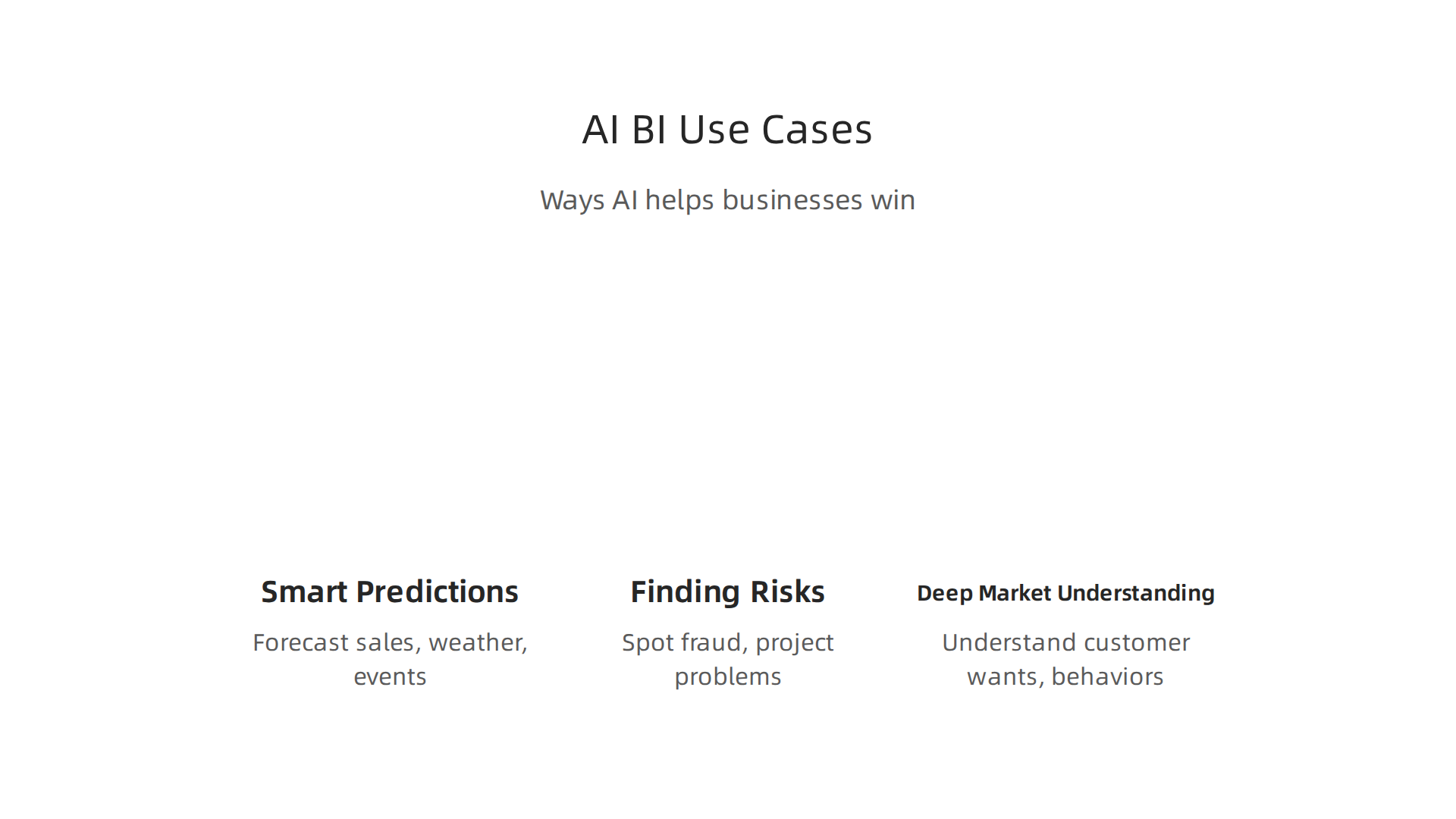
- Smart Predictions for Supply Chains: AI can look at lots of information, like past sales, weather, and upcoming events, to guess what people will buy. This helps companies know how much to order and where to send it. For example, some grocery stores use AI to manage their products, making sure shelves are always full. This kind of AI helps businesses make faster, smarter choices, giving them a big AI advantage over others.
- Finding Risks and Stopping Problems: AI can quickly spot weird patterns in money data to find fraud or other money risks. It can also help see problems coming in big projects before they get too bad.
- Deep Market Understanding: AI helps businesses understand what customers really want. It looks at what people say online, what they buy, and how they use products. This helps companies find new ideas and sell more things. This is where the best AI tools for research help uncover important market insights. One company even used an AI use case to turn data into insights for their business.
AI makes decisions much quicker and more correct. This means companies can react faster to changes in the market or new problems.

This quick and accurate decision-making helps lower "decision latency," which is the time it takes to make a choice. A 2026 report called The State of AI in the Enterprise shows how much businesses are using AI to boost their planning and operations.
When using AI, it's very important to measure how well it's working. This means looking at the return on investment (ROI), or how much money the AI solution saves or earns. But it's also about keeping trust. We must make sure the AI is fair and its answers are true. This is why using ethical, permissioned data is so important for trustworthy AI in business intelligence. This way, all your business intelligence analytics software gives reliable results that everyone can trust. To show this data clearly, many companies also focus on choosing data visualization tools that help tell the story of their insights. This ensures that the insights from AI, whether it's an AI infographic maker creating visual reports or complex analytics, are always clear and truthful.
To make sure AI insights are truly clear and truthful, we need strong technical steps behind the scenes. This is where topics like MLOps, data governance, and special privacy methods come in. They are like the hidden parts of a machine that make sure everything runs smoothly, fairly, and keeps private information safe.
MLOps: Keeping AI Models Working Well
MLOps is a set of practices for managing the whole life of an AI model. Think of it like a careful plan for how AI models are made, used, and checked regularly. It helps businesses keep their AI tools useful and reliable, giving them a real AI advantage.
Key parts of MLOps include:
- Continuous Monitoring: This means watching AI models all the time, even after they are put to use. It helps catch problems early, like if the model starts giving wrong answers because the data it sees changes. This keeps the AI trustworthy and effective for business intelligence analytics software.
- Data Versioning: This is like keeping different saved copies of your data. It helps you track changes in the data used to train AI models. If a problem pops up, you can go back and see exactly what data was used at different times. This is very important for knowing why an AI model makes certain choices. Good data governance for MLOps ensures that these data versions are well-managed.
Good MLOps helps companies build trustworthy AI with robust data pipelines. It ensures the AI models stay fair and accurate over time, which prevents "Synthetic Drift" where data or insights get twisted over time.
Data Governance: Managing Data with Care
Data governance means having clear rules and processes for how a company collects, stores, uses, and protects its data. It's about making sure data is high quality, accurate, and used in an ethical way. For AI, this is super important because AI learns from data. If the data is bad or biased, the AI will be too. Good data governance also helps with data protection services to solve the AI trust crisis by keeping information safe and private.
Privacy-Preserving Methods: Protecting Personal Information
Even when using data for AI, it's vital to protect people's private information. This is especially true for business intelligence, where data might contain sensitive customer details. Two important ways to do this are:
- Differential Privacy: This method adds small amounts of random "noise" to data before it's used by AI. This makes it very hard to figure out specific details about any one person in the data, even while the AI can still find general patterns. Think of it like blurring individual faces in a crowd photo so you can still see the crowd, but not pick out one person. Studies show how differential privacy works with federated learning to keep data private.
- Federated Learning: This smart method allows AI models to learn from data without the data ever leaving its original spot. Instead of sending all the data to one central place, the AI model goes to the data. It learns from many different local devices or computers, and only the lessons (the updated parts of the model) are sent back to a central server, not the raw data itself. This keeps sensitive information on local devices. Research highlights how federated learning with differential privacy can offer strong privacy.
These methods help businesses get insights from data without putting people's privacy at risk. They show how companies can have an AI advantage while still being responsible. This balance of using data smartly and keeping it safe is key for building truly trustworthy AI in 2026.
To really trust AI in 2026, it's not enough to just make sure its data is good and private. We also need to keep checking the AI models themselves.
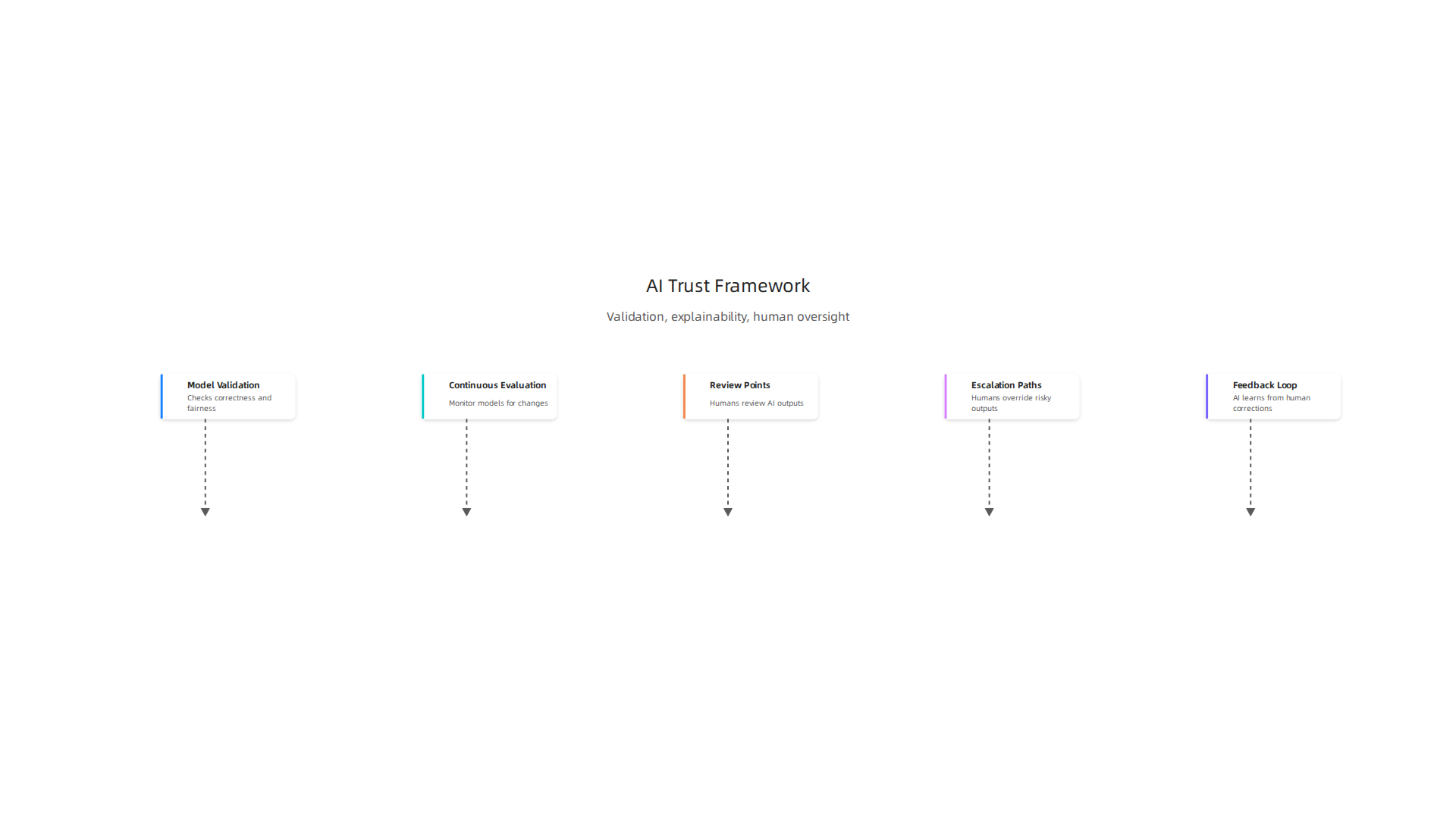
This means making sure they keep working correctly, that we can understand how they make choices, and that humans are ready to step in if needed. This is how businesses gain a true AI advantage.
Operationalizing Trust: Validation, Explainability, and Human-in-the-Loop Controls
Checking AI Models Continuously
Imagine building a car. You wouldn't just build it and hope it runs forever without checks, right? It's the same for AI models. We need strong ways to check them all the time. This includes model validation and continuous evaluation.
- Model Validation: This is like giving the AI a report card to make sure it's doing what it was designed to do. It checks if the AI's answers are correct and fair. This step is super important before an AI model starts helping with business intelligence analytics software.
- Continuous Evaluation: Even after an AI model is working, we must watch it closely. Data in the real world changes. If the data an AI sees changes a lot, the AI might start giving wrong or biased answers. This is called "synthetic drift." To fight this, we use methods like keeping a small part of real data for comparison and refreshing the AI when problems show up, according to tips for Synthetic Data for AI Training: Quality & Legal…. Tools that track where data comes from and how it changes, known as Data Lineage: End-to-End Lifecycle Mapping, are key here. They help us see the full path of data, from where it began to how it was used by the AI. Having clear records of every bit of data helps prevent issues when organizations use AI, as shown in what happens when pharma organisations deploy AI without clear lineage and consent tracking.
These checks help businesses prevent problems and build trust. They make sure the AI continues to offer a real AI advantage, especially with new tools like AI infographic makers that rely on accurate data.
Making AI Easy to Understand
Sometimes, AI models can be like a "black box," meaning it's hard to see how they make decisions. But for people to trust AI, especially in important business settings, we need to understand its reasoning. This is called "explainability."
Explainable AI shows us the steps or reasons behind an AI's output. For example, if an AI recommends a certain business decision, explainability helps us see why it made that recommendation. This builds confidence in the AI's results and helps stakeholders (people who have a say in the business) feel more comfortable. It also helps us catch errors or biases that might otherwise be hidden.
Humans Working with AI
Even the best AI models need human oversight, especially for big or important tasks. This is where "human-in-the-loop" controls come in.

It means designing systems where people review and approve AI decisions, especially for "high-stakes" outputs from business intelligence tools.
Here’s how it works:
- Review Points: For crucial decisions, the AI might give a recommendation, but a human must check it before it goes forward. This is like a second pair of eyes.
- Escalation Paths: If the AI gives a strange or risky answer, there needs to be a clear path for humans to step in, check the issue, and override the AI if needed. This ensures that serious problems are caught and handled by people.
- Feedback Loop: When humans make corrections or decisions, that information can be fed back to the AI. This helps the AI learn and get better over time, further preventing synthetic drift.
By adding humans to the loop, we ensure that AI systems are not just smart, but also responsible. This approach is key to developing trustworthy AI in business intelligence and is a big part of getting a lasting AI advantage. With these controls, businesses can use the best AI tools for research with greater confidence, knowing that both technology and human wisdom are at play.
For AI to truly work for us, it's not enough to just make sure it's reliable and understandable. We also need to measure its impact and guide it toward making things better for people in the long run.

This is how we keep a real AI advantage, beyond just the tech itself.
Measuring and Sustaining AI Advantage: Metrics, Incentives, and Societal Alignment
After putting humans in charge to oversee AI, the next step is to actually measure if the AI is bringing the benefits we hoped for. This means looking at more than just quick numbers. We need to measure how AI helps our business, builds trust, and makes things better for people.
How We Measure AI's Success
To know if an AI is truly giving us an AI advantage, we look at different kinds of measurements:
- Numbers that Show Growth (Quantitative Metrics): These are the easy-to-count things. For example, has the AI helped us make more sales? Has it made our work faster? Does it save money? For businesses using AI, these might show up as better results from business intelligence analytics software. For example, an AI infographic maker can show how quickly information is shared and understood, which can be a key part of how the AI helps. We want to see how AI helps the business grow and become more efficient.
- Feeling Good and Trust (Qualitative Metrics): These are harder to count but just as important. Does the AI help customers feel happier? Do employees trust the AI's suggestions? Is the AI helping people feel more connected or less stressed? For example, when AI systems help with tasks, do they free up humans for more creative or meaningful work? These "soft" benefits are very important for true human flourishing. Many guidelines, like the Data and AI Ethics Framework from GOV.UK, highlight the need for AI to respect human values and well-being.
By looking at both types of measures, we get a full picture of the AI's impact.
Guiding AI for Long-Term Good
It's tempting for businesses to focus on quick wins with AI. But for a lasting AI advantage, we need to guide AI to focus on long-term value. This means setting up rules and rewards (incentives) within our organizations to make sure AI does good things for everyone, not just for a moment.
- Focus on Real Value: Instead of just making AI grab more attention, we need it to help people in meaningful ways. This could mean using AI to solve big problems, improve health, or help people learn new things. The ASEAN Guide on AI Governance and Ethics points out that AI should aim to benefit human society, including people's well-being and happiness.
- Rules and Best Practices: Governments and big groups around the world are creating rules for how AI should be used. These rules often focus on making AI fair, safe, and open about how it works. For example, there are 2026 guidelines on the ethical use of artificial intelligence and data in teaching and learning to help educators use AI responsibly. Businesses can also look to frameworks like the Federal Data Strategy Data Ethics Framework to guide their own AI use. These guidelines help make sure AI is used ethically and builds trust.
- Looking to the Future: Companies should encourage their teams to think about how AI can help society in the long run. This means thinking about ethical choices, data privacy, and how AI can improve our world, not just a company's bottom line. In 2026, many organizations are realizing that a trust-first AI strategy is critical for sustainable growth and public acceptance.
By linking AI's success to these broader goals, businesses can make sure their AI investments create a positive, lasting impact for everyone. This is a crucial step for gaining a lasting AI advantage.
Summary
This article explains why simply using AI is no longer enough and how organizations must pursue an actionable "AI advantage" by embedding trustworthy AI into business intelligence. It outlines the main obstacles—AI bottlenecks, synthetic drift, poor data integrity, and trust erosion—and shows how these problems degrade decision-making. The piece then walks through practical fixes: align C-suite goals to BI outcomes, collect permissioned and provenance-tracked data, apply differential privacy and federated learning, and keep a portion of real data with synthetic sets to preserve truth. It describes essential operational practices such as MLOps, continuous validation, explainability, and human-in-the-loop controls that maintain model reliability. Finally, the article covers how to measure impact with both quantitative ROI and qualitative trust metrics and why governance, ethics, and long-term incentives are critical for sustaining an AI advantage.
Related Blogs
No Similar Blogs found
