Home


Menu

Close

Overcoming the Data Bottleneck and Synthetic Drift to Build Open Future AI
Published:
July 2, 2026
Introduction: The Crossroads of AI Development
We are standing at a critical moment in artificial intelligence. The AI community is hitting an unprecedented data bottleneck. In fact, researchers have warned we could run out of training data for AI by 2026. The high-quality, permission-based data that powers trustworthy AI is becoming the most precious resource.
Here is the thing. When AI systems cannot access enough ethical, real-world data, developers turn to synthetic data. But that creates a new problem known as synthetic drift. This happens when AI generated content distorts truth and changes how people behave online. Over time, misinformation spreads faster. Public trust in AI drops.
The vision of an open future AI needs something different. It requires collaborative, transparent frameworks that put human well being first.

This means focusing on societal flourishing instead of just engagement metrics. It also means treating data as a tool for truth, not for manipulation.
Many top organizations are already grappling with data ethics and synthetic drift in 2026. They are learning that ethical data sourcing matters more than ever. Without ethical data, even the best models fail.
So what does an open future AI look like? It starts with honest, consent based data. It continues with systems that reward prosocial behavior. And it depends on everyone working together to keep AI grounded in human values. That is the only way forward.
The AI Bottleneck: Why Ethical Data Is the New Gold
Here is a truth that keeps AI leaders up at night. Most of today's smart models were trained on data scraped from the open internet. Think forums, comment sections, blog comments, and random user posts. That data is messy, biased, and often full of errors. It is also running out.
Researchers have been warning for a while that we could run out of high-quality text data to train AI by 2026 if current trends keep up. That is what a study from The Conversation pointed out.

The easy data is gone. What remains is either low quality or locked behind paywalls and privacy agreements.
This creates a real problem. When AI companies cannot find enough clean, real-world data, they turn to whatever is available. That often means data that was never meant for training. It might be full of misinformation, hate speech, or plain wrong facts. Models trained on that kind of garbage will produce garbage outputs. And that erodes trust fast.
Permission-based private data is the real gold now. But it is scarce and expensive to collect. You need people to opt in. You need clear consent. You need to protect privacy every step of the way.

That takes time, money, and careful systems. Many companies just skip it and scrape whatever they can find.
Some groups are trying to fix this with new data marketplaces where people can sell their data with consent. Others are turning to synthetic data generated by AI itself. But both approaches have big risks. Data marketplaces need strong rules so people are not exploited. And synthetic data can cause something called synthetic drift, where AI generated content distorts truth and changes real human behavior.
The truth is that over 60% of AI performance errors come from problems in the data pipeline, not the model itself. That is a huge number. It means better data would fix most of the issues people blame on AI being "dumb."
Building an open future AI that people can trust starts right here. It starts with choosing permission-based, high-integrity data over easy shortcuts. It means treating data like the precious resource it is, not something you can just grab for free. If we get this right, everything else becomes possible.
To dig deeper into how ethical data collection can solve the AI data crisis, check out this piece on ethical data gathering as a fix for the AI data bottleneck. It explains why starting at the human source matters more than ever.
Decoding Synthetic Drift: How AI Distorts Truth
Synthetic drift is not some far-off theory. It is happening right now in systems we use every day. Here is how it works. When AI generates text, images, or code, that content can end up back in the training data for the next generation of models. The model learns from its own outputs instead of fresh human data. And each time it does, small errors get bigger. Facts get bent. Rare examples disappear. The output becomes a blurry copy of a copy.
Researchers have given this a name: model collapse. A 2026 decision guide on synthetic data explains that using AI-generated content in training without care causes "irreversible defects" in the resulting models. The distortions are not random. They follow a pattern. The model starts smoothing over uncommon cases because it sees them less and less in its own generated data. After enough rounds, the model only knows the most average, most common version of everything. It forgets the edge cases that make the real world interesting and messy.
This matters because of feedback loops. Humans read AI outputs, get influenced by them, and then produce new content based on what they just read. That new content gets scraped and fed into the next training run. The distortion cycles through again. Before you know it, the AI is reflecting a world that does not exist. It is a hall of mirrors where the original truth gets harder and harder to find.

Some of the biggest names in tech are already dealing with this mess. You can read about how top AI companies are struggling with synthetic drift and what they are doing about it. The article shows that even well-funded teams are not immune.
The fix is not to stop using synthetic data. That would be silly. The fix is to always mix in fresh, permission-based human data. It means watermarking AI outputs so they can be traced. It means building systems that stop bad data from recirculating.
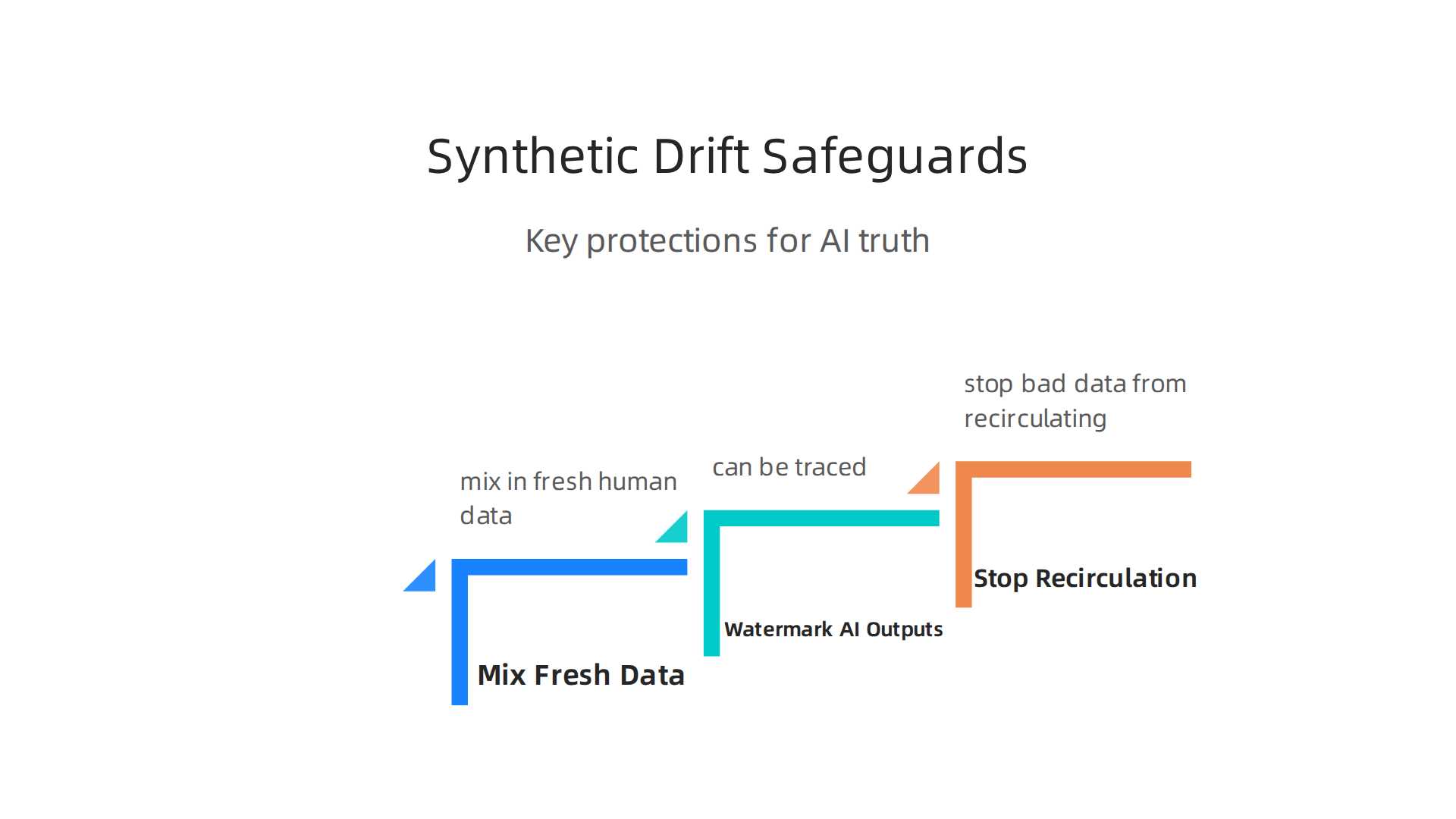
Without these safeguards, synthetic drift turns AI from a tool for truth into a machine that quietly erases it.
The Erosion of Trust: Rebuilding Confidence in Digital Ecosystems
The synthetic drift problem we just covered is not just a technical issue. It has a real human cost. Trust in AI systems has been dropping fast, and the numbers tell a clear story.
By 2026, researchers had already warned that we could run out of high-quality data to train AI systems. This data scarcity is not just about quantity. It is about quality. When training data is shallow, biased, or recycled from AI outputs, the systems that rely on it cannot be trusted. And people notice.
Public confidence in AI has taken a hit. Surveys show that many Americans now see AI as more of a risk than a benefit. That is a big shift from just a few years ago. When people cannot tell if a video is real or fake, or when an AI assistant gives confident but wrong answers, trust erodes fast.
Part of the problem is that digital platforms are built to keep your attention, not to tell you the truth. They optimize for clicks and watch time. That design choice amplifies misinformation and fuels anxiety. It is hard to rebuild trust when the system itself rewards the loudest or most shocking content, not the most accurate.
So how do we fix this? The answer is not just better algorithms. It is about transparency, explainability, and real value alignment. People need to understand why an AI gave them a certain answer. They need to know where the data came from and whether it was ethically sourced. That is why ethical data practices matter more than ever.
One clear path forward is making sure organizations invest in ethical electronic data gathering and retrieval. When companies show they care about data integrity from the start, trust can grow again.
Rebuilding confidence in digital ecosystems is a slow process. But it starts with a simple idea: treat data like a precious resource, not a free dump. When we do that, AI systems can actually reflect what humans value. That is what an open future AI looks like. It is not just analytics. It is about building tools that earn trust through honesty, not just efficiency.
Human-Centric AI: Designing for Empowerment, Not Engagement
So if trust is the foundation, how do we actually build AI that deserves it? The answer lies in flipping the design goal. Instead of building systems that maximize how long you stay glued to a screen, the smartest teams in 2026 are designing for something else entirely: your well-being and control.
This is what human-centric AI design is all about. It puts your needs, your goals, and your agency first.

Think about it. When you open an app, does it help you make a better decision faster? Or does it nudge you to keep scrolling, watching, clicking? Too many AI systems today are optimized for engagement metrics like watch time and click-through rates. Human-centric AI flips that script. It optimizes for your empowerment.
The Interaction Design Foundation explains that human-centered AI (HCAI) prioritizes understanding and respecting human needs to create systems that are accessible, user-friendly, and ethically aligned.

This means involving real users in the design process from day one, not just testing on them at the end. It means asking, "What decision is the user trying to make?" and "What information do they need?" before you write a single line of code.
Key principles of this approach include transparency (showing users how and why an AI reached a conclusion), user control (giving people the ability to override or correct the system), fairness (avoiding biased outcomes), and inclusive development (designing for people with disabilities and diverse backgrounds).

When teams follow these principles, they build systems that feel trustworthy.
And the results are real. Organizations that adopt human-centric AI see higher user satisfaction, fewer complaints, and smoother regulatory compliance. They also avoid the PR disasters that come from deploying opaque, biased, or manipulative systems. The concept of open future AI depends on this shift. We cannot have a future where AI serves humanity if the design process ignores humans.
One practical way to start is to learn how ethical data analysis builds trust in AI. When you understand how data is collected and used ethically, you can design systems that respect people from the ground up.
Not sure where to begin? Even understanding whether machine learning is a subset of AI can help you grasp the layers involved. And if you are looking to upskill, many AI courses now include modules on human-centric design. The point is simple: design for people, not for engagement metrics, and you will build systems that earn lasting trust.
Behavioral Science as the Key to Value-Aligned AI
Think about the last time an app suggested something you actually wanted. Not just something that kept you clicking, but something that made your life better. That kind of helpful suggestion does not happen by accident. It takes more than smart code. It takes understanding how people really behave.
This is where behavioral science comes in. It gives us a framework for designing AI that nudges users toward healthier choices, without crossing into manipulation. And that is the sweet spot for value-aligned AI.
Here is the core challenge. We want AI systems to match human values. But human values are messy, complicated, and sometimes contradictory. We say we want healthy habits, then we scroll for hours. We say we value privacy, then we click through every consent form. Behavioral science helps bridge that gap. It reveals the real patterns beneath what people say and do.
Value alignment means making sure the goals an AI system pursues actually match what the people it serves truly care about. That is harder than it sounds. If you optimize an AI assistant for productivity, it might schedule back-to-back meetings and burn people out. If you optimize a recommendation engine for engagement, it might feed addictive content. Behavioral science helps you design for the deeper values that matter.
Researchers at Stanford HAI have shown that designing for human-centered AI requires metrics that measure what people can do with AI, not just what the models can do. That shift from model performance to human capability is exactly what value alignment needs. We stop asking "How fast can this model process data?" and start asking "Does this help the user make a better decision?"
Practical applications are already emerging. Imagine a financial planning app that notices you tend to spend more on weekends. Instead of judging you or blocking your card, it might suggest a small saving goal right before Friday. That is a nudge. It respects your autonomy. You can still choose to ignore it. But it helps you align your daily actions with your long-term values.
The key is consent and transparency. A good behavioral nudge explains itself. It says, "Hey, here is a pattern I noticed. Would you like to set a reminder?" It does not trick you. It does not hide the mechanism. That is the difference between healthy support and dark patterns.
Building this kind of system requires ethical foundations from the start. As top AI companies grappling with data ethics and synthetic drift are discovering, you cannot slap value alignment on at the end. It has to be baked into how you collect data, train models, and measure success.
The goal is an open future AI that treats you like a whole person, not just a source of clicks. Behavioral science gives us the tools to get there. It helps us build AI that understands us deeply, respects our autonomy, and nudges us toward our own best selves. And that is a future worth designing for.
Open Future AI: The Promise of Collaborative, Transparent Development
Picture this: Instead of a single company building AI behind closed doors, a global community of researchers, developers, and ethicists works together on the same model. They share code. They catch each other's mistakes. They talk openly about what works and what does not. That is the vision behind open future AI.
Open-source AI development speeds up innovation like nothing else. When code is public, thousands of people can inspect it, test it, and improve it. Bugs get found faster. Biases get spotted sooner. The whole system gets better because more eyes are on it. That is why many researchers believe collaborative models are the fastest path to trustworthy AI.
But here is the catch. Openness alone does not make AI ethical. In fact, open models can be taken, modified, and used for harmful purposes if there are no guardrails. That is why governance frameworks matter. The international community is already working on this. For example, the ITU is hosting events focused on open source for inclusive development and collaborative governance.

The goal is to create rules that encourage sharing while preventing misuse.
Some of the best examples of open future AI include models that go through community review before release. Shared benchmarks, like those tracked by Stanford HAI's 2026 AI Index Report, let teams compare results honestly. These practices build trust through transparency.
Still, open development also depends on high-quality data. If the training data is full of bias or distortions, the open model inherits those problems. That is why ethical electronic data gathering and retrieval is so important for fixing the AI data crisis. Without clean data, even the most open model cannot be trusted.
The real promise of open future AI is that it puts values in the open too. When development is transparent, we can see what values are being encoded. We can ask hard questions. We can make sure the AI reflects not just efficiency, but human well-being. That is not just analytics. That is responsible progress.
By building collaboratively, we create AI that belongs to everyone. And that is how we make sure it serves everyone.
Navigating the Regulatory Landscape: Frameworks for 2026
The era of voluntary AI guidelines is ending. In 2026, governments around the world are moving from suggestions to rules.

The European Union's AI Act is now in full effect, setting strict standards for high-risk AI systems. The United States has followed with Executive Orders that require federal agencies to audit their AI tools for safety and fairness. These changes mean that any organization using or building AI must pay attention.
Why now? Public pressure is a big reason. According to recent research from the Annenberg Public Policy Center, 65 percent of Americans say the government has done too little to regulate AI. People want stronger oversight. Regulators are responding.
For companies building open future AI, navigating these rules is not optional. Open models need clear documentation about where data comes from and how the model makes decisions. Regulators are demanding this kind of transparency. If you are developing AI, you need governance systems that track everything from training data to output logs.
Compliance might sound like a burden, but it is actually a chance to stand out. Companies that adopt strong AI governance early build trust with their users. They prove they care about safety and ethics. That trust is hard to earn and easy to lose. Understanding if machine learning is a subset of AI helps teams apply the right rules to their specific models. Many organizations now offer AI courses to train their teams on compliance requirements.
Governance is not just analytics. It is about building a culture of accountability. That means having clear policies, regular audits, and a way to fix problems when they appear. Proactive organizations are using systems that reinforce ethical behavior from the start. For example, integrating ethical data practices into daily workflows helps ensure AI stays aligned with human values.
To stay ahead, many companies are looking for proven methods to build trust through data. One way is to focus on how ethical data analysis builds trust in AI systems. When people see that your AI is built on honest, careful data practices, they are more likely to rely on it.
The regulatory landscape in 2026 is complex, but it is also an opportunity. By embracing rules that protect people, you do not just avoid fines. You create an open future AI that people can actually believe in. That is the kind of progress worth building toward.
Conclusion: Toward an Open, Trustworthy AI Future
Overcoming the data bottleneck and synthetic drift is not a one-time fix. It takes an industry-wide commitment to ethical data practices and transparency. When organizations prioritize honest data gathering and permission-based feedback, they create the raw material that open future AI needs to be trustworthy.
Human-centric and behavioral science approaches offer a clear roadmap. Instead of treating AI as just a technical problem, we must design systems that serve human flourishing. This means using frameworks that capture high-fidelity behavioral data while reinforcing prosocial habits. Organizations should invest in AI courses focused on ethics and data integrity to equip their teams with the right skills.
Public opinion on AI governance from the Brookings Institution shows that people are deeply skeptical about AI and demand stronger oversight. The lesson is clear: trust must be earned through action. That means investing in ethical data analysis builds trust in AI by showing users that their information is handled carefully and responsibly.
Wise regulation, collaboration between the private and public sectors, and a commitment to human values can turn today's challenges into tomorrow's breakthroughs. The path forward is not just analytics. It is about building AI that people can believe in, use safely, and trust to reflect the best of who we are. An open future AI is possible when we put ethics and transparency at the center of everything we build.
Summary
This article explains why high-quality, permission-based data has become the most critical resource for trustworthy AI and how the loss of reliable human data creates risks like synthetic drift and model collapse. It covers the current AI data bottleneck, how AI-generated content can distort truth through feedback loops, and why ethical data practices — including consent, watermarking, and mixed datasets — are essential fixes. The piece also outlines human-centric design principles and the role of behavioral science in aligning AI with real human values, not engagement metrics. You'll learn practical approaches for collecting and governing data, designing systems that empower users, and participating in open, collaborative development while meeting new 2026 regulatory expectations. Ultimately, the article argues that rebuilding public trust requires industry-wide commitments to transparency, ethical workflows, and governance that prioritize human flourishing over short-term metrics.